CoinSpider
Research Log No. 2TodayTopic: Base patterns
How Does Bottom Formation Affect Today's Potential Board and Review?
Today's scan of 516 Binance USDT spot trading pairs found only 4 passing all hard filters. Among the top 10 on the potential board, POLYX and SC have higher bottom-formation scores. The review council opened 4 cases and approved 2, with no red-flag veto; the Technicals reviewer cast 3 buy votes and 1 wait vote. The publicly approved signals GALA and C98 each received 4 votes. The sample size is small; observe cautiously.
Key points- The coin selection funnel is extremely strict, from 516 trading pairs to 4 passing hard filters, with the bottom-zone condition being a key filter.
- Bottom-formation scores vary significantly within the potential board, making it a key indicator for distinguishing sideways consolidation from a falling continuation.
- The review council approved only 2 samples, and there is only 1 closed signal, so statistical significance is limited, and continued tracking is needed.
Today's Funnel: From 516 to 4
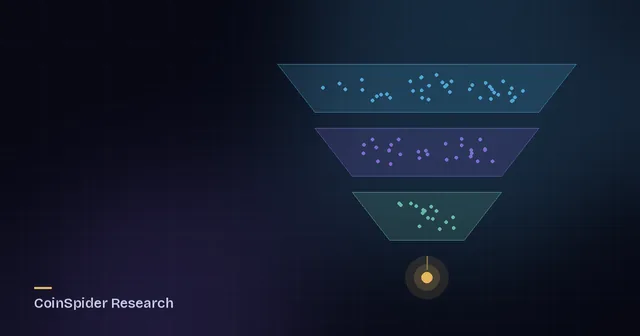
The latest full-market scan (snapshot) shows 516 Binance USDT spot trading pairs, 264 within the research market-cap range, and only 4 passing all hard filters. Reasons for not passing hard filters include: 212 outside the research market-cap range, 167 with risk tags, 35 not yet in the bottom zone, 78 with insufficient or unstable liquidity, and 2 with too short a listing time. These numbers show the screening is extremely strict, and 'not yet in the bottom zone' directly filtered out 35 targets.
The previous day's snapshot under the same scan had 14 passing hard filters, while today only 4, showing fluctuation. The coin selection funnel is shown in Figure 1, narrowing layer by layer from trading pairs to review council cases opened, then to approvals.
Bottom-Formation Scores: Divergence Within the Potential Board
Among the top 10 on the potential board, the data lists four coins' potential scores and declines from their peaks: POLYX potential score 55, below its peak by 76%; IOST potential score 50, below its peak by 77%; SC potential score 45, below its peak by 72%; OSMO potential score 43, below its peak by 74%. Their bottom-formation sub-scores are: POLYX 17.7, SC 15.4, IOST 10.0, OSMO 9.3.
Bottom-formation scores differ significantly, indicating that the rule engine gives different evaluations when measuring features such as stopped decline and sideways movement, and narrowing amplitude. Figure 2 shows these coins' potential scores and declines from their peaks. It should be noted that the potential board is the result of rule-engine scoring, not selected by AI.
How Reviewers View Bottom Formation
In the past 24 hours review council, the stance distribution of the four AI reviewers: Fundamentals analyst 3 buy, 0 wait, 1 avoid; Skeptic 3 buy, 1 wait, 0 avoid; Technicals 3 buy, 1 wait, 0 avoid; Risk officer 4 buy, 0 wait, 0 avoid. The Technicals reviewer had 1 wait vote, indicating reservations about the quality of certain bottom formations.
Figure 3 shows the stance distribution of the four reviewers. Overall buy votes are the majority, but only 4 cases were opened, a very small sample.
Approved Signals and Live Trading Track Record
The review council opened 4 cases and approved 2, with no red-flag veto; 2 were not approved due to insufficient favorable votes. The publicly approved signals are GALA and C98, each receiving 4/4 buy votes.
In terms of public track record, there is only 1 closed signal, with a win rate of 100%, average per trade 9.89%, median 9.89%, max drawdown 0.0%, average holding 4.4 days; currently 11 open signals. With only 1 closed sample, it is impossible to judge the strategy's effectiveness.
What It Means for Users and Limitations
Users need to understand the system's vertical nature: only a very small number of small-cap coins can pass hard filters and enter review, and the review approval rate is not high (today 4 cases opened, 2 approved). Bottom formation is an important reference but not a deterministic signal; brief pauses during a decline can also be misjudged.
The current sample size is very small, with only 1 closed signal and 2 approved signals, so all conclusions can only serve as observation records. More data accumulation is needed to validate the performance of the bottom-formation strategy among small-cap coins in Binance USDT spot.